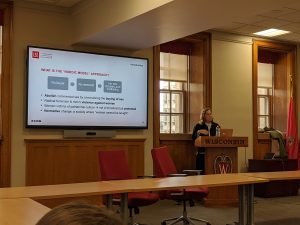
 Students and faculty from several departments listened while Vuolajärvi, drawing on 210 interviews conducted across Sweden, Finland, and Norway, presented findings that complicate dominant narratives about sex work.
Focusing on the effects of the Nordic model, Vuolajärvi found that sex workers remain the primary victims of sex buying criminalization. For instance, third-party laws can lead to evictions or increased surveillance, leaving migrant sex workers (an increasing proportion of sex workers in the Nordic countries) particularly vulnerable to deportation and racialized policing. Moreover, fear of legal consequences often discourages sex workers from reporting incidents to the police, increasing their exposure to violence and deepening stigma. Despite its stated aim of protecting women, the Nordic model, in practice, does little to decrease the precarity of those it claims to support.
Vuolajärvi attributed the global appeal of the Nordic model to what she described as “new humanitarian” discourses that emphasize rescue and protection, as well as its promise of an “easy fix” to the highly visible suffering often portrayed in media representations of sex work. Its perceived legitimacy is further reinforced by the reputation of Nordic countries as leaders in welfare policy and gender equality.
In considering alternatives, she highlighted the potential of removing criminal penalties altogether, alongside implementing broader forms of social support that address economic vulnerability. Her presentation led to many questions from the audience and much discussion among audience members after her talk.
We thank Professor Vuolajärvi for this insightful and thought-provoking talk. This visit was made possible due support from the Department of Anthropology, and the Department of German, Nordic, and Slavic+ and CGES.